

When children transform a cardboard box into a rocket, a blanket into a castle or a stick into a magic wand, it might look like they’re “just playing.”
In reality, they are developing some of the most valuable skills they will ever learn.
In a world where artificial intelligence is changing how we work, learn and solve problems, many parents naturally wonder how they can prepare their children for the future.
The answer may be simpler than you think.
Long before children learn to code or use technology, they develop creativity, communication, problem-solving and resilience through child-led learning and imaginative play.
The importance of imaginary play has never been greater.
Rather than being something children eventually grow out of, imagination could become one of the greatest advantages they carry into adulthood.
What Is Imaginative Play in Early Childhood?
Imaginative play (sometimes called pretend play or imaginary play) is when children use their imagination to create stories, roles, characters and experiences.
It might involve:
- Pretending to be doctors or firefighters.
- Building a rocket from cardboard boxes.
- Running a pretend café.
- Creating magical worlds with small toys.
- Dressing up as superheroes or animals.
- Inventing stories with dolls or puppets.
Unlike structured activities with a right or wrong answer, imaginative play is open-ended. Children make the rules, solve problems and decide where their ideas will take them.
Why Is Imaginative Play Important?
Many adults think imaginative play is simply fun – this understates the importance if imaginary play in early childhood
While it certainly is enjoyable, it is also one of the richest forms of learning available.
Research from UNICEF and the LEGO Foundation highlights that learning through play helps children develop imagination, creativity, problem-solving and the social and emotional skills that underpin lifelong learning.
Through pretend play, children naturally develop:
- Creativity
- Communication skills
- Confidence
- Emotional understanding
- Problem-solving
- Social skills
- Independence
- Language development
Rather than practising isolated skills, children are combining many different areas of development at the same time.
How Imaginative Play Supports Child Development in Early Childhood
Every imaginative game requires children to think, adapt and respond.
One moment they may be deciding who will be the shopkeeper.
The next, they are negotiating rules with friends, solving disagreements or inventing entirely new storylines.
Imaginative play in early childhood provides the foundations for many of the skills children will continue to build throughout school and later life.
Without realising it, children are developing important life skills, including:
Communication
Explaining ideas, listening to others and using new vocabulary.
Problem-Solving
Finding creative solutions when something doesn’t go to plan.
Emotional Development
Understanding feelings through role play and storytelling.
Confidence
Making decisions independently and leading their own play.
Creativity
Using everyday objects in completely new and imaginative ways.
These experiences build strong foundations for future learning.
What Skills Do Children Learn Through Pretend Play?
When children pretend to be astronauts, vets or chefs, they are developing much more than their imagination.
They are learning how to:
- Think creatively.
- Ask questions.
- Work as a team.
- Solve unfamiliar problems.
- Adapt when plans change.
- Communicate ideas.
- Understand different perspectives.
- Persevere when challenges arise.
These are skills that will support children throughout school and well into adult life.
Why Imaginative Play May Matter Even More in an AI World
Artificial intelligence is becoming increasingly capable of finding information, analysing data and completing routine tasks.
What makes people different is our ability to imagine something that does not yet exist.
Children naturally do this every day.
A cardboard box becomes a spaceship.
A handful of leaves becomes dinosaur food.
A living room becomes an enchanted forest.
Imagination encourages children to ask “What if?” rather than simply accepting what already exists.
These qualities help drive innovation, creativity and original thinking.
If you’d like to explore this idea further, read our article on What Skills Will Children Need in an AI World?, where we discuss why creativity, curiosity and communication may become some of the most valuable human skills in the future.
Encouraging Imaginative Play and the Development of Pretend Play at Home
Parents do not need expensive toys to encourage imaginative play.
Often the simplest resources inspire the biggest ideas and support the development of pretend play.
When children are given open-ended materials rather than toys with a single purpose, you are encouraging imaginative play. Children are free to invent, explore and create their own worlds.
Try offering:
- Cardboard boxes.
- Blankets and cushions.
- Dressing-up clothes.
- Wooden blocks.
- Natural materials collected outdoors.
- Toy animals and figures.
- Kitchen utensils for pretend cooking.
The aim is not to direct children’s play but to give them the freedom to explore, invent and create.
Sometimes the best thing adults can do to encourage imaginary play is simply step back and let children’s imaginations take over.
How We Encourage Imaginative Play at The Nook Nursery
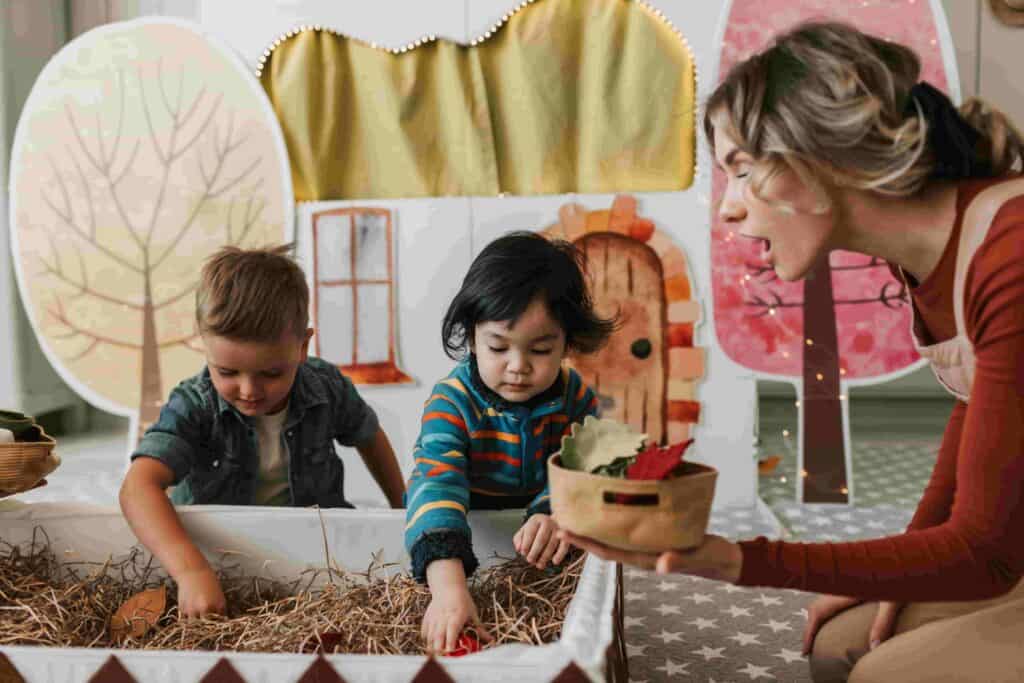
At The Nook Nursery, we understand the importance of imaginary play.
Imaginative play is woven into everyday life.
Rather than following formal lessons, we create rich environments where children can explore their own interests through child-led, play-based learning – which is how to encourage imaginary play.
Whether children are building rockets, creating imaginary worlds or acting out everyday experiences, they are developing creativity, confidence, communication and problem-solving in ways that feel joyful and natural.
Rather than interrupting children’s play, our practitioners use in-the-moment planning to observe children’s interests, ask thoughtful questions and introduce new opportunities for learning while their ideas are unfolding.
These are not simply nursery activities.
They are the foundations of lifelong learning.
Why Imaginative Play Is More Important Than Ever
As the world continues to change, we cannot predict exactly what today’s children will do when they grow up.
What we do know is that imagination has always driven discovery, creativity and innovation.
Children who are encouraged to imagine, question, explore and create are developing qualities that will help them adapt to whatever the future brings.
At The Nook Nursery, we believe imaginative play is not a break from learning.
It is one of the most powerful ways children learn.