

There is so much we want to share about life at The Nook Nursery.
The beautiful environments we create. The invitations to play. The tiny moments of discovery. The friendships forming. The muddy hands, the paint-covered fingers, the stories, the laughter and all of those wonderful moments that make early childhood what it is.
But there is something you will rarely see on our social media.
The children themselves.
And that is a very deliberate choice.
As a nursery in Leyton, we know that sharing photos of children online can be a wonderful way for families to see what happens in a setting. But we also believe that children’s privacy deserves careful consideration in an increasingly digital world.
This is why we’ve chosen a different approach to nursery social media photos.
When Did Childhood Become Content?
Social media has changed the way we share our lives.
A photograph can be taken and, within seconds, shared with hundreds or thousands of people. For nurseries, social media can be a wonderful window into a setting. It allows families to see our environment, understand our approach and get a feel for what makes a nursery special.
But somewhere along the way, we started asking ourselves a different question.
Just because we can share a child’s image, does that mean we should?
A baby cannot understand what it means for their photograph to be placed online.
A two-year-old cannot understand a digital footprint.
A three-year-old cannot truly understand what they are agreeing to when an adult asks, “Can I take your picture?”
They may happily say yes.
But are they consenting to the photograph being seen by strangers? Being shared? Being saved? Existing online years after they have left nursery?
Of course not.
They simply cannot understand those things yet.
And that really made us think.
What Is Sharenting and Why Does It Matter?
Sharenting is the term used to describe parents or carers sharing information, photographs and other content about their children online.
It is something that has become completely normal for many families. Birth announcements, first steps, birthday photographs, family holidays and everyday moments can all become part of a child’s online history.
There is nothing inherently wrong with parents wanting to celebrate their children.
But sharenting raises an important question:
How much of a child’s childhood should be shared before they are old enough to decide for themselves?
The same question applies when nurseries post photos of children on social media.
A photograph that seems completely innocent today can become part of a child’s digital footprint. Once something has been shared online, it can be copied, saved or reshared beyond the original audience.
Young children cannot fully understand those consequences.
At The Nook, we think that is worth considering carefully.
Children’s Digital Footprint Can Begin Before They Can Speak
Most adults think of a digital footprint as something they create themselves.
For today’s children, it can begin much earlier.
A photograph shared when a child is a baby could potentially remain online for years. Their childhood can have an online history before they are old enough to understand what the internet is.
That doesn’t mean every photograph shared online is harmful.
It simply means that privacy of children on social media deserves thoughtful consideration.
As parents and early years professionals, we make countless decisions on behalf of young children.
But where those decisions create a permanent or semi-permanent online record, we think it is worth asking whether the child should have some say in that story later.
Consent Is Bigger Than Saying “Yes”
At The Nook, we talk a lot about children’s voices.
We want children to have choices. We respect when they don’t want to participate. We encourage independence and autonomy. We believe their feelings, preferences and boundaries matter.
So for us, privacy became part of that same conversation.
If we genuinely believe children have rights, dignity and agency, those principles shouldn’t stop when we pick up a camera.
Children deserve the opportunity to grow up and decide for themselves how much of their childhood they want to exist publicly online.
Some children may grow up and love sharing their lives.
Others may want very little online presence at all.
We don’t know yet.
And that is exactly the point.
It should be their choice to make when they are old enough to understand it.
Can Nurseries Post Photos of Children?
This is a question parents may reasonably ask when choosing a nursery.
Can nurseries post photos of children online?
The answer depends on the circumstances, the setting’s policies and the permissions that have been provided. Nurseries need to consider privacy, safeguarding and data protection when taking and sharing photographs of children. These considerations form part of the wider approach we take to keeping children safe at The Nook Nursery.
At The Nook, we wanted to ask a slightly different question.
Not simply:
“Are we allowed to post this?”
But:
“Do we actually need to?”
Parental consent is incredibly important. Parents make decisions on behalf of their children every single day.
But having permission doesn’t automatically mean that every photograph needs to be published publicly.
Do we need to show a child’s face to demonstrate beautiful play?
Do we need to show a child eating lunch to talk about mealtimes?
Do we need a photograph of children sitting together to explain our approach to learning?
We realised the answer was usually no.
That small change in thinking completely changed the way we approached nursery photos on social media.
The ICO’s guidance also highlights that consent needs to be specific, informed and unambiguous, rather than simply being a blanket permission to use personal information.
Our Nursery Photography Policy: Sharing Less, Thinking More
Our approach to photography is not about banning photographs.
Photography has an important place in early years practice.
Photographs can help us document children’s experiences, communicate with families and capture moments that parents will treasure.
The difference is between documenting a child’s experience for them and their family and publishing that child’s identity to a wider online audience.
Those are two very different things.
Our approach to nursery photography is therefore deliberately thoughtful.
Before sharing an image publicly, we consider what purpose it serves, whether the child is identifiable and whether the same story can be told without revealing their identity.
Sometimes the answer is to share the photograph.
Often, we find that the story can be told just as well without it.
So How Do We Share Nursery Life?
We still want families to see what happens at The Nook.
We are incredibly proud of our nursery.
So we share childhood without turning children into content.
You might see a beautifully prepared environment waiting to be explored.
You might see a table after a very busy morning of painting.
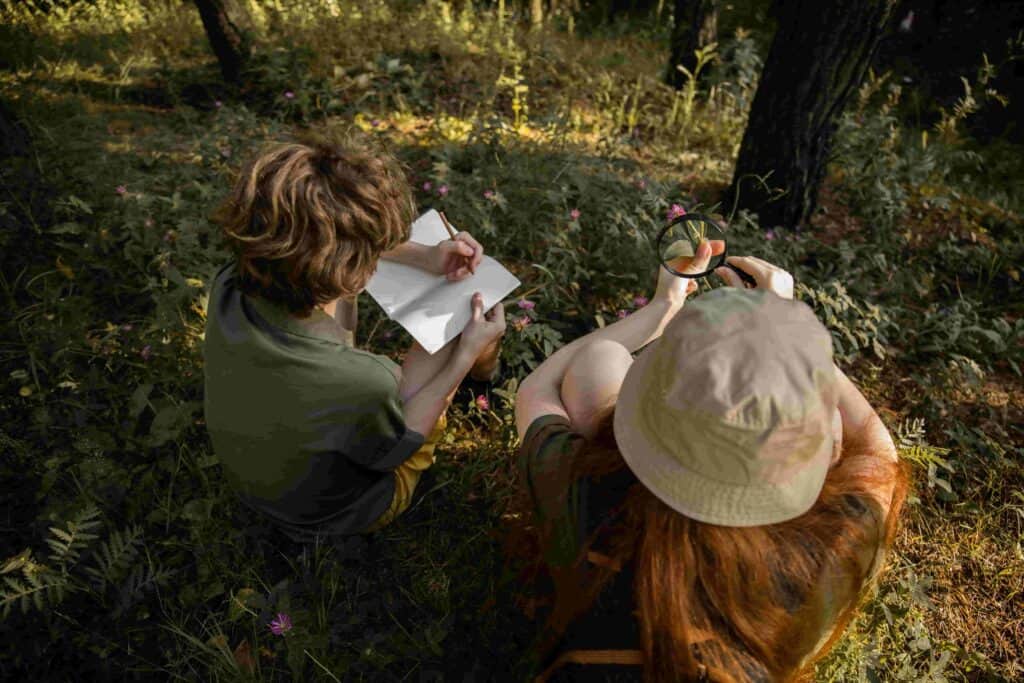
You might see tiny hands investigating something interesting, photographed carefully without identifying the child.
You might see the trail of a play experience — the blocks that became a house, the loose parts that became a birthday cake or the storybook that suddenly inspired an entire morning of play.
Sometimes, the most interesting photograph isn’t the child at all.
It is what they left behind.
Because those traces tell us something about how children think, explore and learn.
And actually, making this decision has challenged us to become more thoughtful storytellers.
Instead of simply photographing children playing, we have to think about what the play is telling us.
This is closely connected to our approach to in-the-moment planning, where practitioners observe children’s interests and use those observations to extend learning.
Why We Don’t Need to Show Children’s Faces
One of the simplest ways to protect children’s privacy online is also one of the most obvious:
We don’t always need to show children’s faces.
A photograph of a child’s hands carefully mixing paint can tell a story.
A muddy pair of wellington boots can tell a story.
A half-built construction can tell a story.
A table covered in natural materials can tell a story.
A collection of paintings can tell a story.
None of these photographs needs to identify the child who created them.
This approach allows us to share the character of The Nook while being much more careful about sharing photos of children online.
We Aren’t Judging Other Families or Nurseries
This is important to us.
Every family makes their own decisions about their child’s online presence, and every early years setting will have its own policies and approach.
Our decision isn’t about telling parents what they should post.
It isn’t about criticising nurseries that share photographs with appropriate consent.
And it certainly isn’t about creating fear around technology.
It is simply something we have chosen for The Nook.
The digital world has changed incredibly quickly, and children growing up today are experiencing something no previous generation has experienced in quite the same way.
Their childhood can have an online history before they can even speak.
We think that deserves careful thought.
Childhood Doesn’t Need an Audience
There is something else behind our decision too.
We want The Nook to feel like a place where childhood can simply happen. It is also why we value child-led learning, giving children the freedom to make choices, follow their interests and develop their own ideas.
Not every beautiful moment needs to be photographed.
Not every learning experience needs to become a post.
Not every wonderful thing a child does needs an audience.
Sometimes a child can spend twenty minutes transferring stones between two bowls and the only people who ever know about it are the child and the adult quietly sitting beside them.
And that moment still matters.
Maybe even more so.
Because childhood isn’t a performance.
Protecting Children’s Privacy in a Digital World
The question of children’s privacy online isn’t going away.
As technology becomes an even greater part of everyday life, parents and early years settings will continue to make decisions about photographs, social media and children’s digital identities.
We don’t think there is one answer that works for every family.
But we do think the conversation is worth having.
When we share a photograph of a child, we can ask:
Who needs to see this?
Why are we sharing it?
Could we tell the same story without identifying the child?
And perhaps most importantly:
Would the child choose to share this themselves if they were old enough to understand?
For a baby or toddler, we cannot know the answer.
So we choose to err on the side of privacy.
Their Childhood. Their Story. Their Choice.
One day, the children in our nursery will be teenagers and adults.
They will have their own phones, their own social media accounts and their own opinions about privacy.
We don’t know what choices they will make.
But wherever possible, we would like them to begin making those choices with something incredibly valuable still intact:
their privacy.
At The Nook Nursery in Leyton, protecting childhood isn’t only about keeping children physically safe.
It is about protecting their dignity.
Their identity.
Their boundaries.
And their right to decide which parts of themselves they eventually choose to share with the world.
Until they are old enough to make that decision?
We are very happy for their play to tell the story instead.
Because their childhood belongs to them.